
Projects
Mindzheimer VR – Detecting Alzheimer’s Disease Severity using VR and Machine Learning
Comprehensive Summary
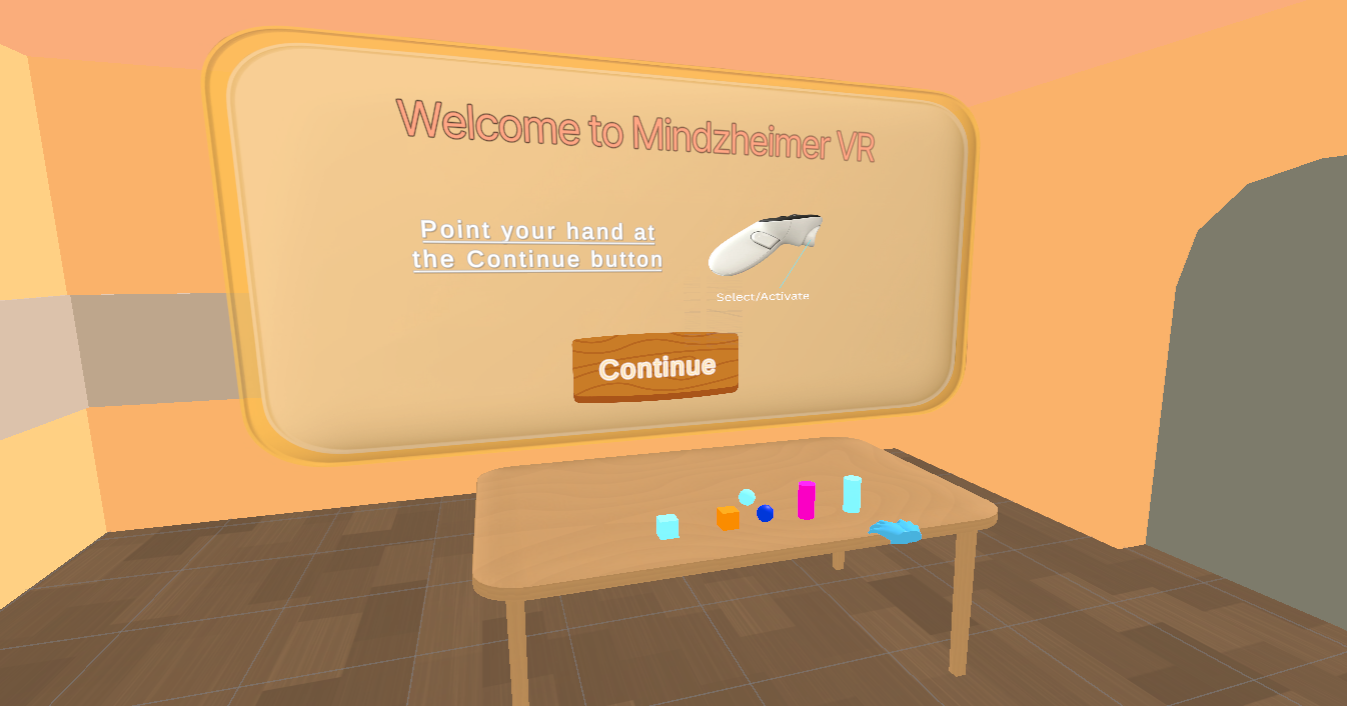
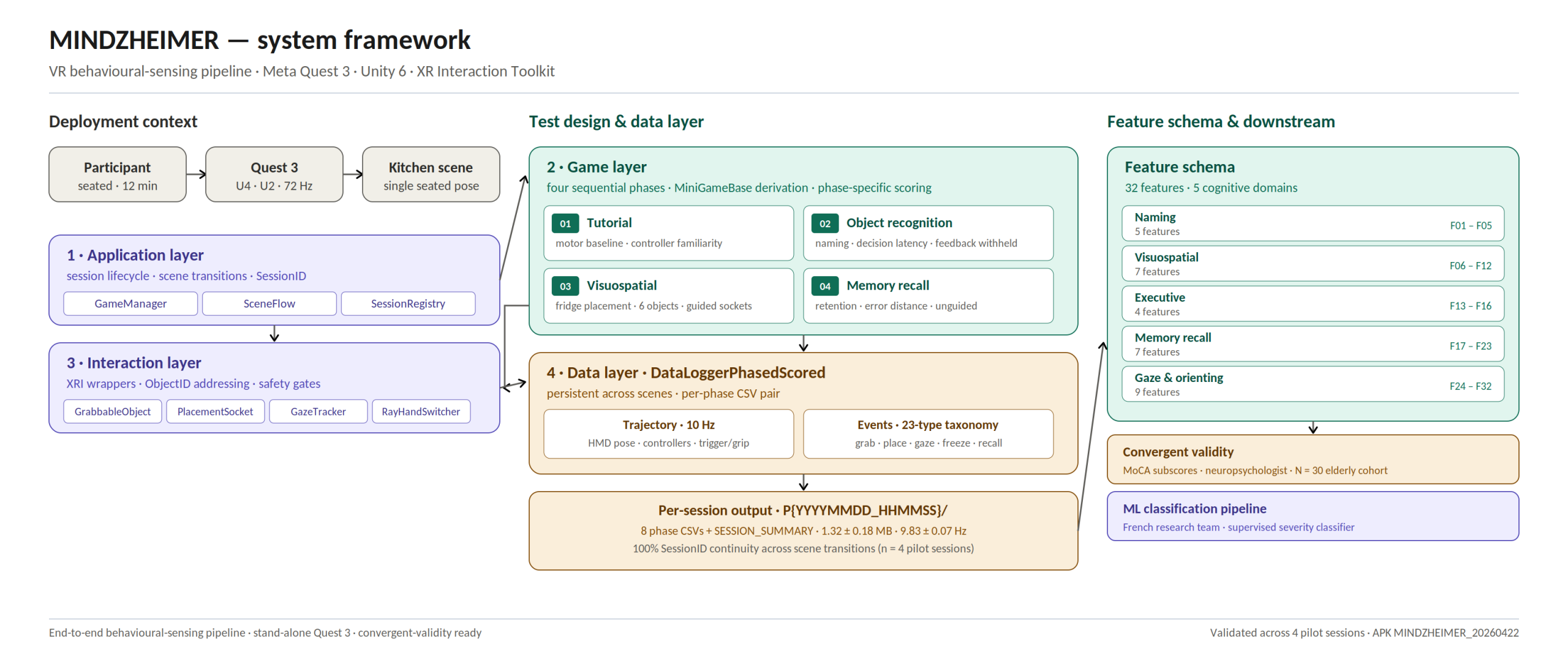
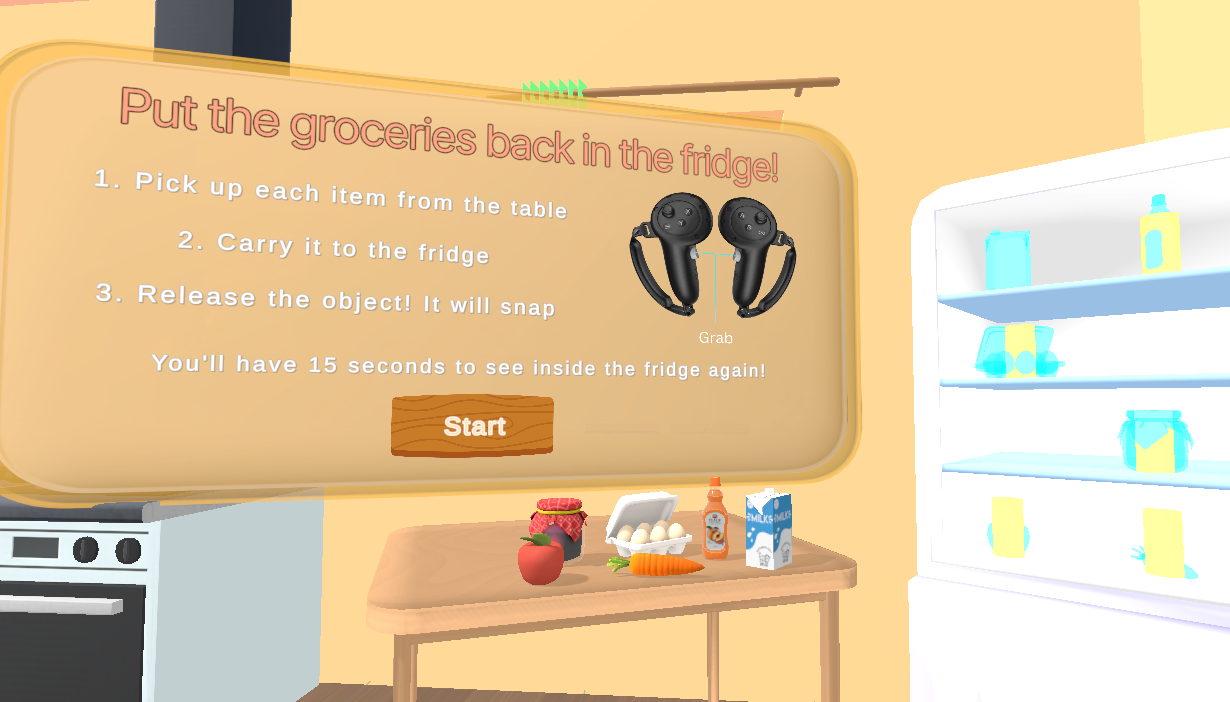
MINDZHEIMER is a stand-alone virtual reality cognitive assessment platform for Meta Quest 3 that reframes early-stage dementia screening as a continuous behavioural-sensing problem rather than a paper-and-pencil scoring exercise. Built in Unity 6 with the XR Interaction Toolkit under a four-layer software architecture, the system administers four sequential phases — Tutorial, Object Recognition, Visuospatial fridge-placement, and Memory Recall — inside a single seated kitchen environment that eliminates locomotion as a confound for elderly users. A dual-stream data layer emits, per session, four 10 Hz trajectory CSVs capturing HMD and bilateral controller pose alongside four discrete event CSVs structured around a 23-type behavioural taxonomy that includes three novel diagnostic events (PRE_TASK_SCAN, POST_REJECTION_GAZE, OBSERVATION_SCAN_SUMMARY) operationalising orienting attention, error monitoring and encoding effort as machine-readable rows. From this dual-stream output a 32-feature schema is computed across five cognitive domains aligned to MoCA subscales — naming, visuospatial, executive, memory recall, and gaze/orienting — providing the collaborating French ML research team with a deterministic contract for feature extraction independent of the Unity codebase. System-level validation across four complete pilot sessions on two field-deployed headsets confirmed robust 9.83 ± 0.07 Hz sampling stability, 100 % SessionID continuity across all scene transitions, and zero missing files, while a healthy-versus-literature-grounded impaired feature profile contrast demonstrated that the feature space has sufficient dynamic range to express clinically meaningful differences (composite Δ ≈ 0.42). The principal contribution is therefore not a new diagnostic threshold but a complete, low-cost (≈ US$500 hardware), reproducible behavioural-sensing pipeline that bridges paper-based screening and laboratory-grade behavioural neuroscience for early Alzheimer’s detection in community settings — with convergent-validity analysis against MoCA subscores in a target cohort of 30 elderly participants and supervised ML severity classification with the French collaborators positioned as the immediate next steps.
Project Justification
The problem and why it matters. Alzheimer’s disease and related dementias affect an estimated 55 million people worldwide and are projected to reach 139 million by 2050, yet early detection in primary care still depends almost entirely on paper-and-pencil instruments — MMSE, MoCA, CDR — that were designed between 1975 and 2005. These instruments collapse a ten-minute behavioural episode into a single ordinal score and are blind to how the patient arrived at that answer: the latencies, fixations, retracings and self-corrections that distinguish a hesitant pass from a confident one. They require a trained examiner, exhibit ceiling effects in highly educated populations and floor effects in low-literacy ones, and cannot be administered at scale outside the clinic. Meanwhile, consumer VR hardware has crossed an accessibility threshold — a stand-alone Meta Quest 3 costs under US$500 and samples head and bilateral controller pose at 72 Hz with sub-centimetre accuracy — making the entire behavioural process recordable as a structured data stream. The opportunity is therefore not another VR cognitive test but the data architecture that turns any well-designed VR task into a machine-readable computational phenotype suitable for community-scale screening.
Why MINDZHEIMER is positioned to address this gap. MINDZHEIMER is built specifically around three gaps in the published VR cognitive-assessment literature: hardware accessibility (most prior systems still assume PC tethering or external eye-tracking add-ons), data output (most release a single composite score rather than the underlying behavioural stream), and validation design (few systems are explicitly engineered for convergent-validity analysis against a paper anchor). The system runs on a stand-alone Quest 3 with no external sensors, exports a complete 10 Hz dual-stream CSV output structured around a 23-event behavioural taxonomy, and is designed from the ground up for convergent-validity analysis against MoCA subscores in collaboration with a neuropsychologist. Validation across four complete pilot sessions on two field-deployed headsets has already confirmed sampling stability of 9.83 ± 0.07 Hz, 100 % SessionID continuity across scene transitions, and a 32-feature schema with sufficient dynamic range to separate healthy from literature-grounded impaired profiles. The principal deliverable is a reproducible behavioural-sensing pipeline — released independently of the Unity codebase so downstream ML teams can extract features deterministically without engine access — that bridges paper-based screening and laboratory-grade behavioural neuroscience. By doing so, the project supports the immediate research goal of supervised AD severity classification with the collaborating French ML team while creating a clinically deployable foundation for community-scale early-MCI detection at a hardware cost an order of magnitude below existing laboratory-grade alternatives.
Objectives
RO1. To design and develop a stand-alone VR cognitive assessment platform on Meta Quest 3 that administers four sequential phases (Tutorial, Object Recognition, Visuospatial, Memory Recall) within a single seated environment.
RO2. To architect a dual-stream data collection layer with a 23-event behavioural taxonomy and a 32-feature schema across five cognitive domains, producing machine-learning-ready datasets independent of the Unity codebase.
RO3. To validate the platform through pilot deployment and convergent-validity analysis against MoCA subscores in an elderly cohort, establishing the foundation for supervised AD severity classification with the collaborating ML research team.
Phases Of Work
Preliminary Research and Expert Findings
VR System and Data Collection
Machine Learning Classification
Evaluation Metrics
The platform is evaluated along three complementary axes that together capture system quality, data fidelity and clinical relevance. System-level performance is measured by sampling stability against the 10 Hz target (achieved 9.83 ± 0.07 Hz across pilot sessions), session-identifier continuity across all scene transitions (100 % across n = 4 pilot sessions), absence of missing CSV files (0 of 36), and operational metrics including session duration (11.8 ± 1.4 minutes) and battery drain per session (3.4 ± 0.2 %). Data quality and feature-schema validity are measured by deterministic reproducibility of the 32-feature extraction from the dual-stream CSV output, dynamic range of the feature space (demonstrated by a composite MZ_total separation of Δ ≈ 0.42 between healthy and literature-grounded impaired profiles), and successful firing of the three novel diagnostic events (PRE_TASK_SCAN, POST_REJECTION_GAZE, OBSERVATION_SCAN_SUMMARY). Clinical validity is evaluated through convergent-validity analysis in the target N = 30 elderly cohort, operationalised as statistically significant Pearson correlations between MINDZHEIMER feature subscores and the theoretically aligned MoCA subscales (naming ↔ Object Recognition; visuospatial/executive ↔ Visuospatial; delayed recall ↔ Memory Recall) at a pre-registered threshold of p < 0.05 with correlation magnitude r ≥ 0.4 on the primary dimensions.
Estimated Budget
Malaysian Ringgit
Project Timeline
Project initiation and literature review.
January 2025Unity setup and initial prototype
May 2025Pivot to four-phase architecture.
October 2025Data layer and fridge games built.
January 2026Pilot validation and APK Testing
March 2026TESTING, STORYBOARD ALIGNMENT VALIDATION & DEMO BUILD DELIVERY
April 2026Clinical data collection with MoCA.
June 2026ML pipeline and journal submission.
September 2026Thesis submission and defence.
November 2026Get Started
Get In Touch!
It would be great to hear from you! Contact us using the button provided below if you have any inquiries, comments, or if you simply want to say hi. In our ongoing efforts to get better and serve you better, your input is very important to us.